





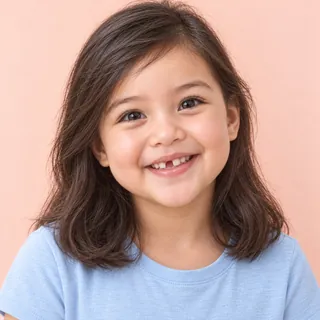

What decides what your baby will look like?
Every baby gets a random half of their genes from each parent. Most features — eye color, hair, height, face shape — are shaped by many genes working together, so nobody can predict them with certainty. That's what makes every baby a surprise! Here's what usually happens.
Eye color
Eye color depends mostly on how much melanin (brown pigment) is in the iris, which is controlled by several genes. Brown tends to win over lighter colors, but two brown-eyed parents can still have a blue-eyed baby.
| Parents' eyes | Most likely | Also possible |
|---|---|---|
| Brown + Brown | Brown | Hazel, green, blue |
| Brown + Blue | Brown | Blue, hazel, green |
| Brown + Green | Brown | Green, hazel, blue |
| Green + Blue | Blue or green | Hazel |
| Blue + Blue | Blue | Green; brown is rare |
These are general tendencies, not guarantees — real eye-color genetics is more complex than any chart.
Many babies are born with lighter eyes that slowly darken during the first year as melanin builds up, so a newborn's eye color may not be final.
Hair color and texture
Darker hair colors tend to show up more often than lighter ones. Red hair is usually recessive — a child typically needs a red-hair gene variant from both parents. Curly hair often appears when one parent has curls, and many kids land in between with waves.
Skin tone
Skin tone is shaped by many genes, so children often land somewhere between their parents — though siblings can still look quite different from each other.
Dimples, freckles and chubby cheeks
Dimples and freckles often run in families, but how they're inherited is more complex than a single gene. Chubby baby cheeks are mostly baby fat, so they say little about adult looks.
Where the AI prediction fits in
Our AI doesn't read DNA — it looks at the visible features in your photos and imagines a baby who blends them. Think of it as a fun, educated preview. Try the couple baby generator a few times and see which features keep showing up!